
Laddu Gopal Size Chart From 0 to 14, How to Measure Your Idol Correctly
Laddu Gopal Size Chart From 0 to 14, How to Measure Your Idol Correctly
Ask any devoted bhakt of Laddu Gopal what their most common online shopping frustration is, and the answer comes back almost universally: wrong size.
The poshak arrives. The packaging is opened with excitement. The embroidery is beautiful. The fabric is exactly right. And then, the poshak is placed on Thakurji and it simply does not fit. Too large and it bundles awkwardly. Too small and it refuses to sit correctly. Either way, the joy of the moment is replaced with the sinking feeling of having to return an order or settle for something that does not quite honour Kanha ji the way you intended.
This happens to thousands of bhakts across India every single year. And in almost every case, it happens for the same reason: the bhakt did not have access to a clear, complete, accurate size chart, or they did not know how to use it.
Daivik Vastram is committed to ending this frustration permanently. This guide gives you the most comprehensive Laddu Gopal size chart available anywhere in India. covering every size from Size 0 to Size 14. along with a complete, foolproof method for measuring your idol correctly so that every poshak you order from this day forward is a perfect fit.
By the end of this guide, sizing uncertainty will be a thing of the past.
-
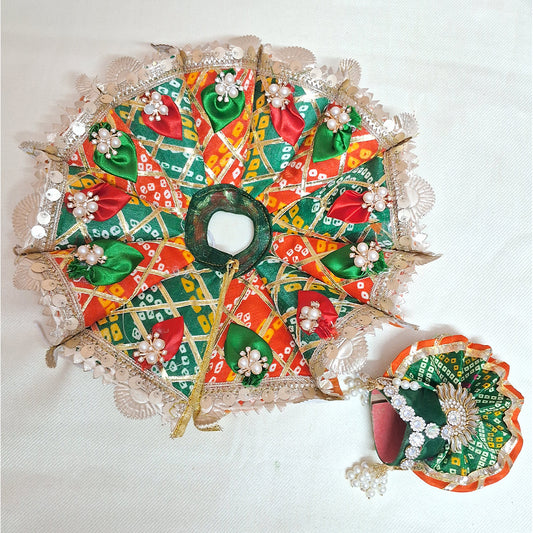
Cone Multicolor Bandhani Laddu Gopal Poshak With Pagadi
Regular price From Rs. 849.00Regular priceRs. 1,199.00Sale price From Rs. 849.00Sale -
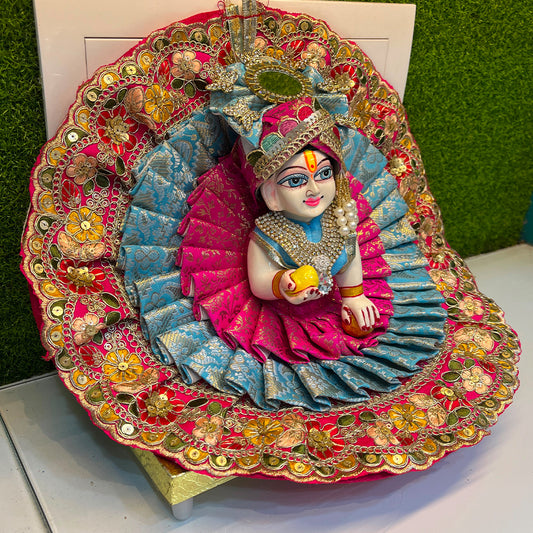
Blue Handcrafted Laddu Gopal Poshak Set with Mukut
Regular price From Rs. 689.00Regular priceRs. 999.00Sale price From Rs. 689.00Sale -
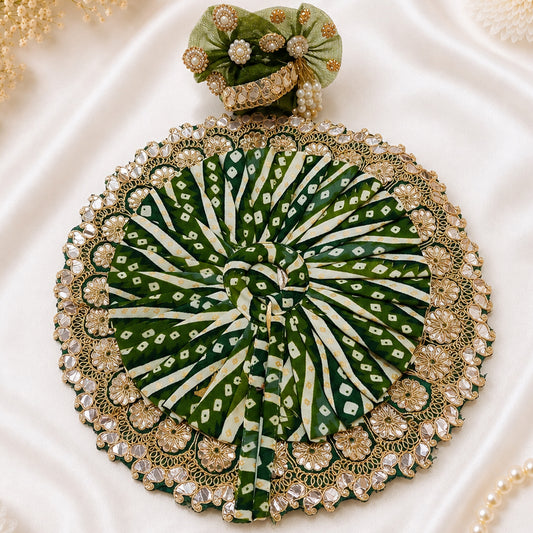
Green Printed Laddu Gopal Poshak with Pagadi
Regular price From Rs. 649.00Regular priceRs. 1,199.00Sale price From Rs. 649.00Sale -
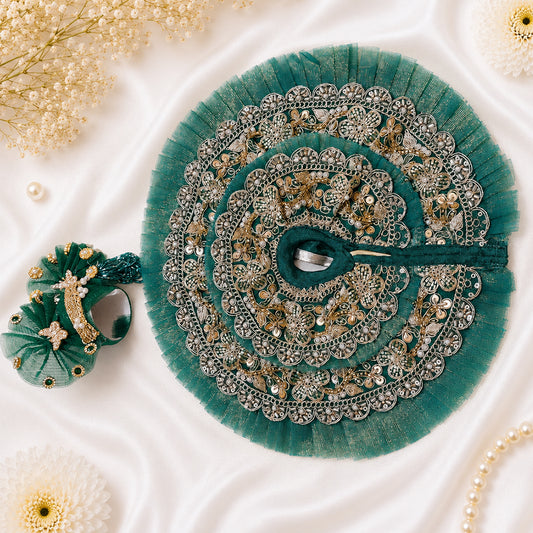
Emerald Green Handcrafted Laddu Gopal Dress with Pagadi
Regular price From Rs. 749.00Regular priceRs. 1,199.00Sale price From Rs. 749.00Sale -
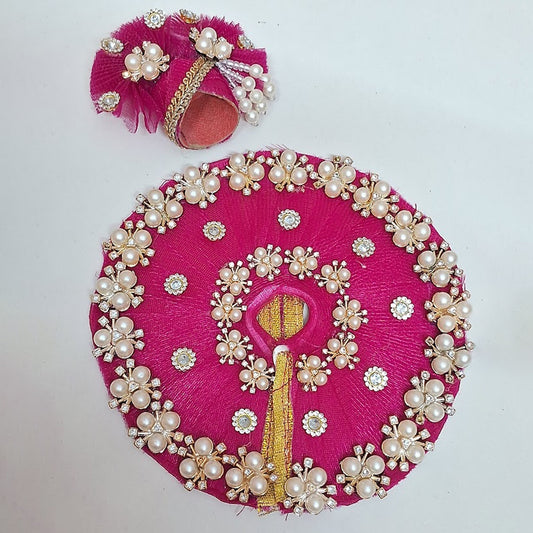
Magenta Laddu Gopal Poshak | Pearl & Navaratna Embellished Kanha Ji Dress With Pagadi | Sizes 0 to 6 | Premium Rani Pink Thakurji Outfit
Regular price From Rs. 549.00Regular priceRs. 799.00Sale price From Rs. 549.00Sale -
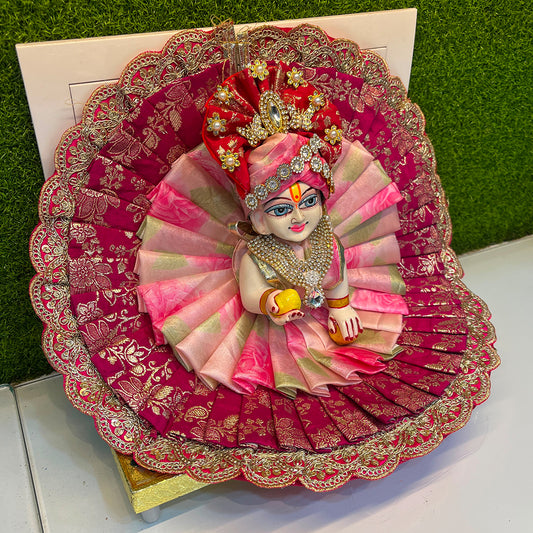
Magenta Handcrafted Laddu Gopal Poshak Set with Mukut
Regular price From Rs. 589.00Regular priceRs. 999.00Sale price From Rs. 589.00Sale -
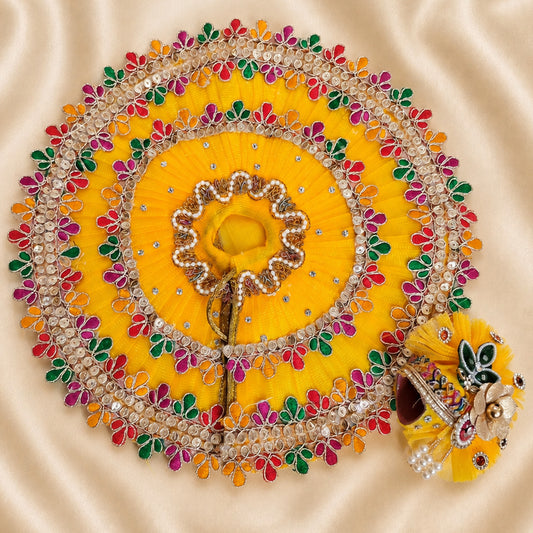
Handcrafted Yellow Laddu Gopal Poshak with Designer Mukut | Krishna Ji Dress
Regular price From Rs. 449.00Regular priceRs. 999.00Sale price From Rs. 449.00Sale -
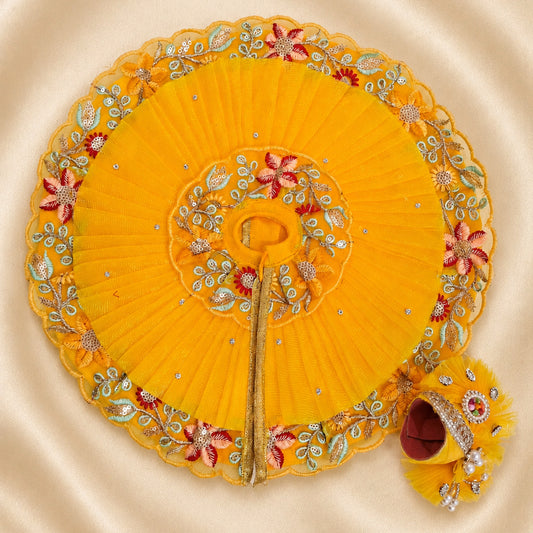
Handcrafted Yellow Laddu Gopal Dress (Poshak) with Mukut | Floral Embroidery Kanha Ji Designer Dress Set
Regular price From Rs. 449.00Regular priceRs. 850.00Sale price From Rs. 449.00Sale








Understanding the Laddu Gopal Sizing System - Basics Every Bhakt Needs to Know
Before we get to the measurements, it is important to understand how the Laddu Gopal poshak sizing system works, because it is fundamentally different from how clothing sizes work for human garments, and misunderstanding this is the root cause of most sizing errors.
Sizing Is Based on Murti Height, Not Weight or Volume
The primary measurement for Laddu Gopal poshak sizing is the height of the murti, specifically, the height of the murti's body from the base (bottom of the feet or lowest point of the idol) to the upper chest or shoulder level. The head, the mukut (crown), and any decorative base or singhasan (throne) are not included in this measurement.
This is the single most important thing to understand. The poshak wraps around the body of the murti. Its size is calibrated to the body trunk, not the full standing height of an adorned Thakurji with mukut and accessories.
Sizes Are Standardised, But Murtis Are Not
The size numbers 0 through 14 are standardised measurements used consistently by Daivik Vastram across its entire collection. However, and this is crucial, murtis are not standardised. Different artisans, different manufacturers, and different regional traditions produce murtis with varying proportions even at what appears to be the same size.
A murti described as "Size 3" by one seller may be noticeably larger or smaller than a murti described as "Size 3" by another seller. This is why you should always measure your specific murti rather than assuming that the size number given by the place you purchased the murti is the correct poshak size.
Two Measurements Are Better Than One
The most accurate poshak sizing uses two measurements together:
- Murti height (base to upper chest), the primary measurement
- Murti body circumference (around the widest point of the body, usually the chest or belly), the secondary confirmation
Using both measurements together virtually eliminates the chance of ordering the wrong size.
How to Measure Your Laddu Gopal Idol Correctly - Step by Step
What You Will Need
- A soft tailoring tape (the flexible kind used for sewing, these are available at any tailor's shop or general store for a few rupees). A rigid metal or wooden ruler will not follow the curves of a murti accurately.
- A pen and paper to note your measurements
- Your Laddu Gopal murti in its usual worshipped position
Step 1 Remove All Accessories
Before measuring, remove the mukut (crown), any mala or haar, and lift the murti off its singhasan. You are measuring the bare murti only. Even a few millimetres added by a decorative base or mukut can push you into the wrong size category.
Step 2 Place the Murti on a Flat Surface
Set the murti on a flat, stable surface in its natural upright position, the same pose it sits in during daily worship. Do not tilt, lean, or prop the murti at an angle.
Step 3 Measure the Body Height
Hold the start of your tailoring tape at the very base of the murti, the bottom of the feet, or the lowest flat point of the idol's body. Run the tape upward along the front of the murti to the upper chest or shoulder level, not to the top of the head.
Read and note this measurement in inches. This is your primary height measurement.
Example: If your tape reads 3.5 inches from base to upper chest, your primary measurement is 3.5 inches.
Step 4 Measure the Body Circumference
Wrap your tailoring tape around the widest part of the murti's body, typically around the chest or belly, depending on the form of your specific idol. Keep the tape snug but not tight.
Read and note this measurement in inches. This is your secondary circumference measurement.
Example: If the tape reads 4.5 inches around the body, your circumference measurement is 4.5 inches.
Step 5 Match to the Size Chart Below
Use both measurements together with the complete Daivik Vastram size chart in the next section to identify your Thakurji's correct poshak size.
Complete Laddu Gopal Size Chart - Size 0 to Size 14
This is the most detailed and accurate Laddu Gopal poshak size chart available from any brand in India. Every size from 0 to 14 is listed with corresponding murti measurements and practical descriptions to help you identify your Thakurji's size with complete confidence.
| Poshak Size | Murti Height (Base to Upper Chest) | Approximate Body Circumference | Description |
|---|---|---|---|
| Size 0 | Up to 1.5 inches | Up to 2 inches | The tiniest Laddu Gopal, barely larger than a thumb. Very rare, used for miniature murtis. |
| Size 1 | 1.5 to 2 inches | 2 to 2.5 inches | Small miniature murti. Delicate and petite. Often kept in travelling puja kits. |
| Size 2 | 2 to 2.5 inches | 2.5 to 3 inches | Very popular home worship size. Small but clearly defined form. One of the most commonly purchased sizes. |
| Size 3 | 2.5 to 3 inches | 3 to 3.5 inches | The most popular size across India for home mandirs. Fits comfortably on most small mandir platforms. |
| Size 4 | 3 to 3.5 inches | 3.5 to 4 inches | Medium-small size. Slightly larger presence in the mandir. Widely kept in dedicated household mandirs. |
| Size 5 | 3.5 to 4 inches | 4 to 4.5 inches | Medium size. A substantial Thakurji with clear visual presence. Popular for prominently displayed mandirs. |
| Size 6 | 4 to 4.5 inches | 4.5 to 5 inches | Medium-large size. Often the main murti in a dedicated mandir room or pooja ghar. |
| Size 7 | 4.5 to 5 inches | 5 to 5.5 inches | Large size. A commanding and beautifully detailed murti. Kept in large home mandirs. |
| Size 8 | 5 to 5.5 inches | 5.5 to 6 inches | Large murti with a strong visual presence. Used in homes with dedicated mandir spaces or raised platforms. |
| Size 9 | 5.5 to 6 inches | 6 to 6.5 inches | Very large home or small community murti. Requires a well-proportioned mandir space. |
| Size 10 | 6 to 6.5 inches | 6.5 to 7 inches | Large community or temple anteroom size. Significant in scale and devotional presence. |
| Size 11 | 6.5 to 7 inches | 7 to 7.5 inches | Substantial temple or large household mandir size. Requires dedicated singhasan and accessories. |
| Size 12 | 7 to 7.5 inches | 7.5 to 8 inches | Temple or institutional mandir size. A genuinely large and commanding form. |
| Size 13 | 7.5 to 8 inches | 8 to 8.5 inches | Large temple murti. Typically found in dedicated mandir rooms, community temples, and religious organisations. |
| Size 14 | 8 to 9 inches and above | 8.5 to 9.5 inches | The largest standard size. Reserved for main temple murtis, institutional worship spaces, and community mandirs. |
Important Note on Measurement Tolerances: Murti proportions vary slightly between craftspeople. If your measurement falls at the upper end of a size range, for example, 3.4 inches in a 3 to 3.5 range, consider moving to the next larger size. A slightly larger poshak always looks more graceful than one that fits too tightly.
Special Cases - When the Standard Size Chart Needs Adjustment
Wide-Bodied Murtis
Some artisans, particularly in certain regional traditions, craft Laddu Gopal murtis with rounder, fuller bodies. The traditional Mathura style murti, for example, often has a wider girth relative to its height than the more slender South Indian or Rajasthani forms. If your murti's circumference measurement suggests a larger size than its height measurement, use the circumference as your primary guide and size up accordingly.
Tall but Slender Murtis
Equally, some murtis are relatively tall but with a narrow body. If your height measurement suggests Size 5 but your circumference reads on the lower end of Size 4, either Size 4 or Size 5 may work, try Size 5 first for a graceful drape, and if it seems too generous in width, go with Size 4.
Non-Standard Poses, Standing, Crawling, or Extended-Arm Murtis
Most Laddu Gopal murtis are in the classic seated or reclining pose. However, murtis in the Makhan Chor pose (one arm extended reaching into a butter pot), or the standing Tribhanga pose, or the crawling baby Krishna pose may require different measurement approaches:
- Crawling murtis: Measure from the base (knees) to the upper chest/shoulder of the murti in its crawling position. The height measurement is taken from the lowest point of the body to the upper chest, even if the murti is not in a traditional upright posture.
- Standing murtis: Measure from the base of the feet to the upper chest/waist level. Standing form poshaks drape differently from seated form poshaks, contact Daivik Vastram customer support for specific guidance on standing murtis.
- Extended arm murtis: Measure the central body trunk. Do not include the extended arm in any measurement. The poshak covers the central body, not the extended limb.
Golden Rule, When in Doubt, Always Size Up
This rule is repeated because it matters so much.
When your measurement falls between two sizes, at exactly 3 inches in a 2.5-to-3 or 3-to-3.5 range, for example always order the larger size.
Here is why: A poshak that is slightly larger than the murti will drape with graceful abundance. The fabric falls naturally, the embroidery sits correctly on the front panel, and the overall look is flowing and beautifully adorned. A poshak that is even slightly too small will pull at the fabric, cause the embroidery to bunch or sit off-centre, and create a visual tightness that simply does not feel right.
You can always create a beautiful look with a slightly larger poshak. You cannot make a too-small poshak work gracefully. Always size up.
Saving Your Measurements Most Time-Saving Habit in Bhakti Practice
Once you have measured your Laddu Gopal murti and confirmed the correct size with a successful Daivik Vastram order, do one simple thing that will save you time and uncertainty for every future purchase: write down your murti's measurements and confirmed size number, and keep it where you can find it easily.
Saveable locations that devoted bhakts recommend:
- Inside the puja drawer or mandir cabinet
- In a dedicated note in your phone under a title like "Thakurji's Measurements"
- Written on the inside of the poshak storage box or bag
- Saved as a note in your Daivik Vastram account
Once confirmed, this single measurement note means that every future poshak order, for Janmashtami, for Diwali, for the winter collection, for a special festival, or for a new design you fall in love with, can be placed in seconds with zero sizing uncertainty.
Why Daivik Vastram's Sizing Is the Most Reliable in India
One of the greatest frustrations bhakts face when shopping across multiple sellers is that size numbers are not standardised across the industry. A "Size 3" from one seller is a "Size 4" from another. There is no universal enforcement of what each number means.
Daivik Vastram uses a fixed, verified size chart that is applied consistently across every single product in its collection, every fabric, every design, every season, every festival. When you confirm your Thakurji's size as Size 3 with a successful Daivik Vastram order, every future Size 3 from Daivik Vastram will fit exactly the same way.
This consistency is one of the most practically valuable things about buying from a dedicated, quality-focused brand rather than from random marketplace sellers or inconsistent local market vendors.
Browse the complete collection with confidence, your size is available: 👉 Laddu Gopal Dress Collection Daivik Vastram
Common Sizing Questions Answered Simply
"My murti came with a size tag saying Size 2 but the measurements suggest Size 3. Which should I trust?" Always trust your actual measurement over the tag. Size tags from murti manufacturers and size numbers for poshaks are from entirely different systems and rarely correspond to each other directly. Measure your murti and use the Daivik Vastram size chart above. Your measurement is always more reliable than any tag.
"I have two Laddu Gopal murtis they both look the same size but measure slightly differently. Should I order the same size for both?" Measure both separately and order the appropriate size for each. Even two murtis that appear visually similar can have meaningfully different body proportions. A poshak that is perfect for one may not work for the other. Two measurements, two size confirmations, two correct poshaks.
"I want to gift a poshak to a fellow bhakt but I do not know the size of their Thakurji." Ask them to measure using the steps in this guide and share the measurement with you. Alternatively, order a Size 3 or Size 4, the two most commonly kept home worship sizes, with the understanding that these cover the most typical range. When in doubt, Size 3 is the single most commonly correct choice for home worship murtis across India.
Ordering With Complete Confidence, Your Next Step
You now have everything you need. The complete size chart from Size 0 to Size 14. The step-by-step measurement method. The special case guidance for unusual murtis. The golden rule for borderline measurements. And the knowledge that Daivik Vastram's sizing is consistent and reliable across every product in its collection.
There is only one thing left to do: measure your Thakurji, confirm your size, and shop.
Every season. Every festival. Every new design you love. With the right measurement noted and a consistent brand to buy from, your Kanha ji will always be dressed in a perfectly fitting poshak for the rest of His seva in your home.
Order your perfectly sized poshak today: 👉 Shop All Laddu Gopal Poshak Sizes Daivik Vastram
Jai Shri Krishna! Radhey Radhey! 🙏
Published by Daivik Vastram | India's Most Trusted Laddu Gopal Poshak Brand Helping Every Bhakt Find the Perfect Size, So Every Poshak Honours Thakurji Perfectly
Frequently Asked Questions
What is the Laddu Gopal size chart and how does it work?
Laddu Gopal size chart maps your murti's body height measured from the base to the upper chest, without the mukut or singhasan, to a numbered poshak size from 0 to 14. Daivik Vastram's size chart is verified and consistent across all products, making it the most reliable sizing reference for Laddu Gopal poshaks in India
How do I measure my Laddu Gopal idol for the correct poshak size?
Use a soft tailoring tape to measure from the base of the bare murti to the upper chest, without the mukut or singhasan. Note this height in inches. Take a secondary measurement around the widest body point as confirmation. Match both to Daivik Vastram's size chart for a perfectly accurate poshak size selection every time.
What is the most common Laddu Gopal poshak size for home worship?
Size 3 and Size 4 are the most commonly used sizes for home worship Laddu Gopal murtis across India. Size 3 corresponds to a murti height of approximately 2.5 to 3 inches from base to upper chest, and Size 4 to approximately 3 to 3.5 inches. Together these two sizes cover the majority of home mandirs in India.
Should I include the mukut height when measuring my Laddu Gopal for poshak size?
Never include the mukut in your measurement. The mukut is removed when dressing Thakurji in a new poshak and its height is not relevant to poshak sizing. Always measure only the bare murti body from base to upper chest. Including the mukut height inflates the measurement and results in ordering a poshak that is too large for your specific murti.
What should I do if my Laddu Gopal measurement falls between two sizes?
Always order the larger size when your measurement falls between two sizes. A slightly larger poshak drapes gracefully and looks beautiful on the murti. A too-small poshak pulls the fabric, distorts the embroidery placement, and cannot be made to look correct. The golden rule without exception: when between sizes, always size up.
Are Laddu Gopal poshak sizes the same across all sellers?
No. Size numbers are not standardised across the industry, a Size 3 from one seller may equal a Size 4 from another. This is why you should always measure your murti directly rather than relying on size numbers from previous purchases elsewhere. Daivik Vastram uses a consistent, verified size chart applied uniformly across its entire poshak collection.
How do I measure a crawling or non-seated Laddu Gopal murti?
For crawling murtis, measure from the lowest body contact point (typically the knees) upward to the upper chest in the murti's natural pose. For standing murtis, measure from the base of the feet to the chest or waist level. Contact Daivik Vastram customer support for specific guidance on unusual murti poses to ensure perfect sizing.
Does Daivik Vastram offer poshaks in all sizes from 0 to 14?
Yes. Daivik Vastram stocks poshaks across the complete size range from Size 0 through Size 14 and above, covering the full spectrum from the smallest miniature murti to large temple-scale idols. All sizes are available across seasonal, daily wear, and festival collections ensuring every bhakt finds the perfect fit regardless of their Thakurji's size.
How do I size a poshak for a wide-bodied Laddu Gopal murti?
For wide-bodied murtis where the circumference measurement suggests a larger size than the height measurement, always use the circumference as the primary guide. Order the larger of the two suggested sizes to ensure the poshak wraps comfortably around the body without pulling. A slightly generous fit always looks more graceful than a tight one.
Once I know my Laddu Gopal's poshak size, do I need to remeasure for every order?
No. Once you confirm your Thakurji's size through a successful Daivik Vastram order, write it down and save it. Because Daivik Vastram maintains consistent sizing across its entire collection, the same size number applies to every future purchase, across all fabrics, all seasons, and all festival collections, without any need to remeasure.


